C3PAO Selection Guide for Small and Medium-Sized Businesses: Strategic Briefing

Executive Summary
Selecting a Cybersecurity Maturity Model Certification (CMMC) Third-Party Assessment Organization (C3PAO) presents a significant challenge for small and medium-sized businesses (SMBs) within the Defense Industry Base (DIB). This briefing document synthesizes a guide produced by the National Defense Information Sharing and Analysis Center (ND-ISAC) to assist Organizations Seeking Assessment (OSAs) in vetting potential assessors.


The central takeaway is the avoidance of two extremes: choosing "bottom of the barrel" assessors whose lack of standards may lead to nullified results, and avoiding assessors who draw unreasonable lines during intake. Instead, OSAs should prioritize assessors who are knowledgeable in CMMC, possess technical aptitude relevant to the OSA’s specific environment, and demonstrate a commitment to risk mitigation. Success requires moving beyond the incentive to find the "easiest" assessor, focusing instead on a reasonable and thorough evaluation to ensure long-term certification validity.
Strategic Selection Framework
The ND-ISAC guide utilizes a scoring system across 11 critical categories. Each category should be evaluated on a scale of 1 to 10 to determine the best fit for an OSA.
1. The Intake and Quote Process
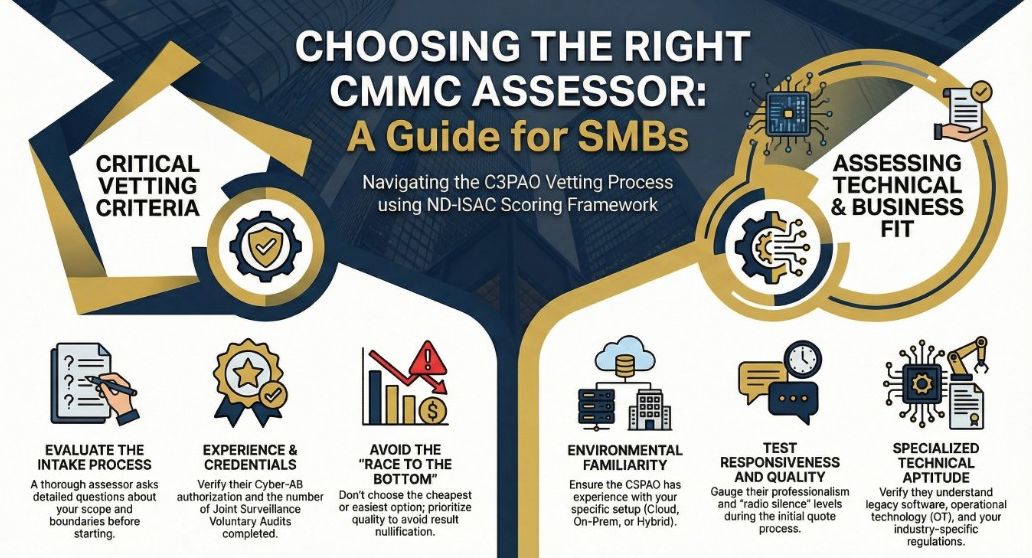
The intake process is arguably the most critical step in determining if a C3PAO is the right fit. It reveals the assessor's familiarity with the OSA's environment and their flexibility.
- Key Indicator: A high-quality C3PAO will ask detailed questions regarding scope and boundaries before accepting a client.
- Essential Questions for OSAs:
- What are your organizational and individual credentials with the Cyber-AB?
- How many Joint Surveillance Voluntary Assessments (JSVAs) have you conducted at our required CMMC level?
- What percentage of your clients achieved conditional or final certification?
- How do you ensure independence and objectivity?
- Can you provide an example of assessment planning documents?
2. Cost and Resource Allocation
While SMBs are often cash-constrained, the lowest cost is not always the most economical choice.
- Strategic Consideration: An inadequate, low-cost assessment that requires a full re-assessment later is ultimately more expensive.
- Vetting Points: OSAs should confirm if the price is fixed or if specific conditions (such as a re-assessment of certain practices) might cause costs to escalate.
3. Availability and Personnel
As CMMC implementation approaches, a bottleneck in the assessment ecosystem is expected.
- Scheduling: OSAs must confirm the expected timeframe for completion and whether the C3PAO offers support or handles discrepancies post-assessment.
- Staffing: Inquire about the number of Certified CMMC Assessors on staff and the projected number of on-site visits.
4. Reasonableness and Subjectivity
CMMC assessments involve areas of subjective judgment. OSAs must find an assessor who interprets standards consistently.
- The "Race to the Bottom": OSAs are cautioned against seeking "easy" assessors, as trustworthiness among DIB stakeholders is vital.
- Implementation Checks: Some assessors review System Security Plan (SSP) implementation descriptions during planning to ensure the OSA's approach is reasonable and not misunderstood.
- Evidence Sufficiency: OSAs should ask what the assessor considers "sufficient" evidence for a control (e.g., one example vs. multiple).
5. Responsiveness and Quality of Service
The professional relationship between the OSA and the C3PAO is a predictor of the assessment's success.
- Communication: OSAs should evaluate how quickly the C3PAO provides quotes and whether they feel like a priority during initial consultations.
- Valuation: OSAs should reflect on whether the assessor seemed distracted during the intake or provided thorough, detailed answers.
Technical Aptitude and Specialized Experience
Assessors must have technical expertise relevant to the OSA’s specific infrastructure.
Technical Expertise Areas
Category | Relevant Inquiries |
Architectures | Experience with enclaves vs. full business enterprises; Virtual Desktop Infrastructure (VDI). |
Development | Familiarity with agile software development infrastructures (e.g., Docker). |
Specialized Tech | Handling legacy software, specialized software, and Operational Technology (OT) that may require compensating controls. |
Service Providers | Experience assessing OSAs that use Managed Service Providers (MSPs), External Service Providers (ESPs), or Cloud Service Providers (CSPs). |
 Baseline Cyber Team
Managed Service Provider (MSP) Considerations
If an OSA utilizes an MSP/ESP, they must determine:
- If the MSP must be assessed prior to or alongside the OSA.
- If the assessor requires proof of business "need" (e.g., DFARS 204.252-7012 flow down) before assessing a service provider.
- The assessor's familiarity with Remote Monitoring & Management (RMM) tools.
Professional and Regulatory Aptitude
Beyond technical skills, the assessor must understand the business and legal environment of government contracting.
- Government Contracting: Inquire about the assessor's years of experience in the field and how they stay updated on changing laws and regulations.
- CMMC Specifics: Participation in DIBCAC assessments, Joint Surveillance Audits (JSAs), and active involvement in industry groups are key indicators of expertise.
- Cross-Framework Experience: Assessors specializing in NIST SP 800-53 (FedRAMP) or CMMI may have expectations that are "significantly different" and potentially "unreasonable" when applied to the CMMC framework.
Environmental Alignment
The guide emphasizes that familiarity with an environment similar to the OSA's is vital for assessment effectiveness. OSAs should look for experience in:
- Specific Industries: Familiarity with standards like AS9100 or ISO9001.
- Work Models: Experience with Bring Your Own Device (BYOD) policies, multiple locations, or work-from-home environments.
- Physical Scope: Experience with on-premise manufacturing vs. hybrid environments, including the assessment of physical assets like data centers and operational sites.
Acronym and Resource Guide
- C3PAO: CMMC Third Party Assessment Organization (authorized by Cyber-AB).
- Cyber-AB: The official accreditation body for the CMMC ecosystem.
- DIBCAC: Defense Industrial Base Cybersecurity Assessment Center.
- JSVA: Joint Surveillance Voluntary Assessment (includes C3PAO and DIBCAC representation).
- OSA: Organization Seeking Assessment.
- SSP: System Security Plan.
- OT/SPA: Operational Technology / Security Protection Assets.